


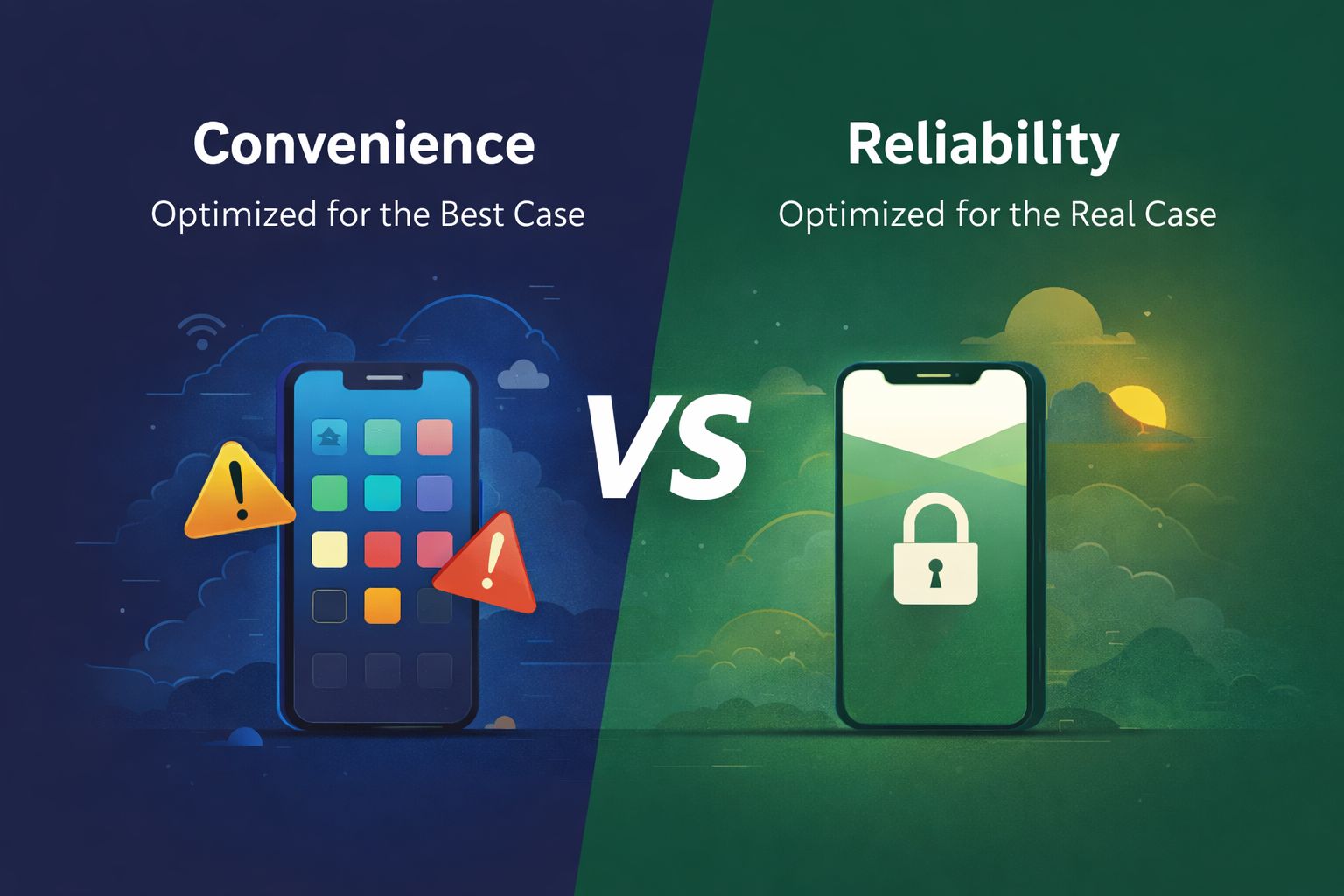
Convenience vs. Resilience: The High Cost of Fragile Software
Modern applications are engineered to feel like magic. One tap, one login, total synchronization. But this “effortless” experience is often a house of cards built on a singular, fragile assumption: that the digital environment will remain perfect forever.
When software is optimized for convenience alone, it dazzles in the boardroom but crumbles in the field.
The “Best-Case” Trap
Convenience-first design is a gamble on ideal conditions. It banks on:
Rock-solid connectivity and low latency.
High-availability server clusters.
Persistent authentication states.
In this vacuum, apps feel seamless. But ignoring the “what-if” scenarios isn’t optimism—it’s architectural avoidance. When the environment shifts, these apps don’t just degrade; they hit a wall.
Reliability: Engineering for the “Real Case”
Resilient software doesn’t ignore friction; it bakes it into the blueprint. It operates under the sober reality that:
Connections flicker and die.
Remote systems bottleneck.
Users get cut off mid-task.
Reliability doesn’t promise a flaw-free existence. It promises continuity under fire. It ensures that even when the supporting cast of servers and APIs disappears, the core tool remains fit for purpose.
The Litmus Test of Failure
Any developer can build a tool that works when the stars align. The true caliber of a product is revealed only when things go south.
When a service is unreachable or a login handshake fails, does the app become a paperweight? If your software folds the moment it loses its tether, it wasn’t designed to be dependable—it was designed to be a demo. Users may not know the technical jargon, but they feel the betrayal of trust when a tool fails them exactly when they need it most.
Calm Tools vs. Feature Bloat
We are currently in an arms race of “feature-heavy” software. On paper, these tools look like Swiss Army knives—packed with endless integrations and deep customizations. In practice, every new dependency is a fresh liability.
Calm tools take the road less traveled. They prioritize:
Predictable behavior over flashy gimmicks.
Minimal surface area for failure.
Silent consistency over constant notifications.
A calm tool doesn’t need a status page to apologize for its existence. It doesn’t scream for attention. It simply stays the course.
Reliability is a Radical Choice
True reliability isn’t a “patch” you apply later; it’s a foundational design decision. It requires the discipline to trim the fat and say “no” to:
Fragile third-party dependencies.
Features that exist only to “keep up with the Joneses.”
Aesthetics that compromise core utility.
Choosing reliability over superficial convenience isn’t a rejection of the future—it’s a commitment to integrity in engineering.
The Moogle Standard At MoogleTechnology, we view reliability as a non-negotiable baseline. Convenience is a luxury; trust is a necessity. The tools that truly endure aren’t the loudest or the most complex—they are the ones that stand their ground when everything else fails.
Leave a Reply